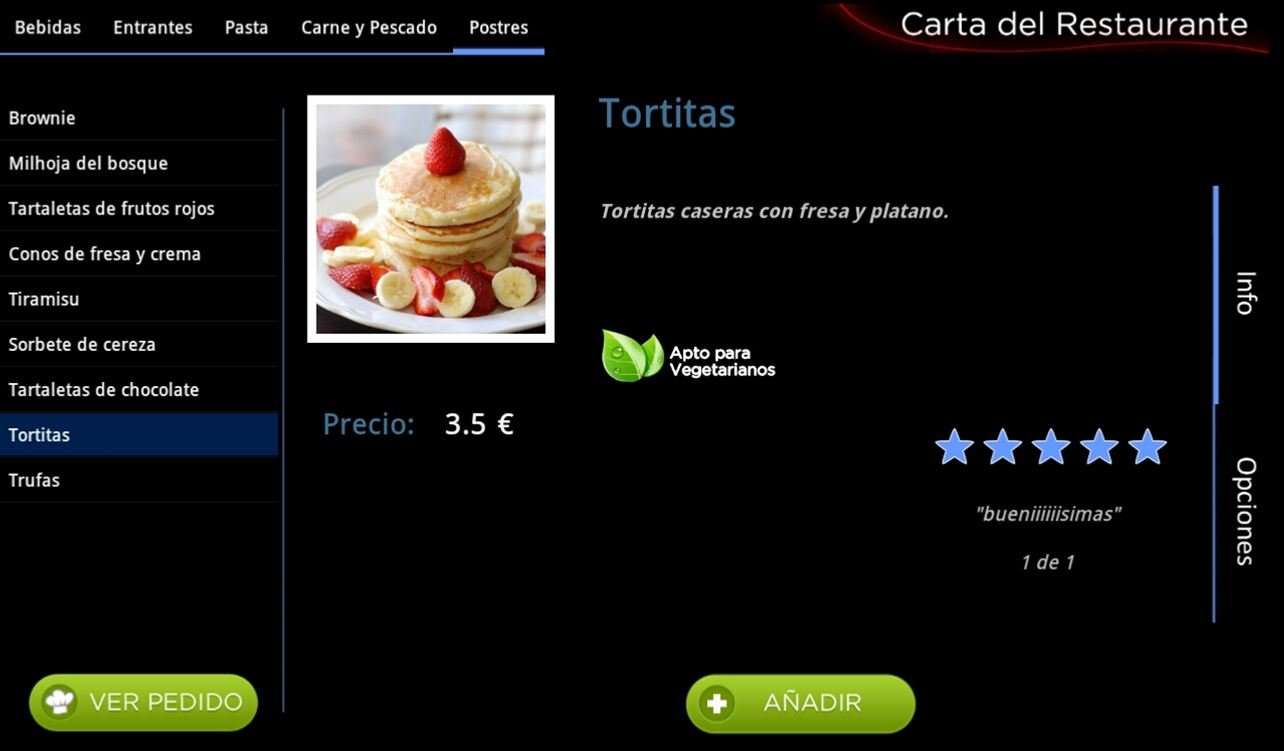
Touch & Eat was an Android-based restaurant ordering and management system.
From the diner's tablet, customers could browse the menu, place orders and interact with the restaurant without having to wait for a waiter to take their order. The system sent orders directly to the kitchen, where they could be managed and prioritised.
Behind the ordering experience, I also designed a management layer that collected and structured the resulting data, allowing restaurant owners to access information and metrics that could help them understand and improve their business.
It was not just an ordering app.
It was an attempt to connect the entire restaurant workflow, from table to kitchen to management.
Touch & Eat era un sistema de pedidos y gestión de restaurante basado en Android.
Desde la tablet del comensal, los clientes podían explorar el menú, hacer pedidos e interactuar con el restaurante sin tener que esperar a que un camarero tomara nota. El sistema enviaba los pedidos directamente a cocina, donde podían gestionarse y priorizarse.
Detrás de la experiencia de pedido, también diseñé una capa de gestión que recopilaba y estructuraba los datos resultantes, permitiendo a los dueños del restaurante acceder a información y métricas para entender y mejorar su negocio.
No era solo una app de pedidos.
Era un intento de conectar todo el flujo del restaurante, de la mesa a la cocina y a la gestión.
Every time I sat down at the table, I would say to my partner:
"Can you imagine when I can just order from the table?"
I kept thinking about the waiting involved in ordering, the dependency on a waiter being available, and what could happen if the process were more immediate.
That curiosity became my final-year project.
At the time, I wasn't thinking in terms of product discovery, hypotheses or user journeys. I simply saw a problem and became obsessed with imagining a solution.
Looking back, that instinct has stayed with me. I've always enjoyed finding opportunities to make everyday experiences work better, particularly around food and hospitality.
Cada vez que me sentaba a la mesa, le decía a mi pareja:
"¿Te imaginas poder pedir directamente desde la mesa?"
No dejaba de pensar en la espera que suponía pedir, la dependencia de que hubiera un camarero disponible, y qué podría pasar si el proceso fuera más inmediato.
Esa curiosidad se convirtió en mi proyecto de final de carrera.
En aquel momento no pensaba en términos de product discovery, hipótesis o user journeys. Simplemente vi un problema y me obsesioné con imaginar una solución.
Mirando atrás, ese instinto se ha quedado conmigo. Siempre he disfrutado encontrando oportunidades para mejorar experiencias cotidianas, especialmente en torno a la comida y la hostelería.
The system had to work for several different people with very different needs. My initial hypotheses:
El sistema tenía que funcionar para varias personas distintas con necesidades muy diferentes. Mis hipótesis iniciales:
The diner
Wants to order easily and avoid unnecessary waiting, while still being able to interact with a waiter when needed.
The kitchen
Needs clear, prioritised and timely information about incoming orders.
The restaurant owner
Needs visibility into operations and useful data to understand what is happening in the business.
El comensal
Quiere pedir con facilidad y evitar esperas innecesarias, sin dejar de poder interactuar con un camarero cuando lo necesite.
La cocina
Necesita información clara, priorizada y a tiempo sobre los pedidos entrantes.
El dueño del restaurante
Necesita visibilidad sobre las operaciones y datos útiles para entender qué está pasando en el negocio.
That made the project much more interesting. I wasn't designing a single interface.
I was designing an ecosystem connecting every actor in the restaurant, each with their own needs and goals.
Eso hizo el proyecto mucho más interesante. No estaba diseñando una sola interfaz.
Estaba diseñando un ecosistema que conectaba a todos los actores del restaurante, cada uno con sus propias necesidades y objetivos.
Everything.
Todo.
This was my first experience taking a product from an idea all the way to a working solution, and I owned every part of it. I:
- Identified the opportunity and defined the initial concept
- Researched existing solutions and competitors
- Analysed the different users and stakeholders
- Interviewed people of different ages to challenge my assumptions and gather different perspectives
- Defined the product scope and MVP
- Designed the user experience, interfaces and workflows
- Designed the database architecture
- Selected the technologies and technical approach
- Developed the Android tablet application
- Developed the server-side solution
- Tested the system end to end
- Presented the final product to my professors as if presenting it to a client
I even bought the first 10-inch Android tablet available in Spain so I could develop and test the experience on the actual type of device I was designing for.
The project was awarded Honors, and my professors later continued using it as an example for other students.
Esta fue mi primera experiencia llevando un producto desde la idea hasta una solución funcionando, y me hice cargo de cada parte. Yo:
- Identifiqué la oportunidad y definí el concepto inicial
- Investigué soluciones existentes y competidores
- Analicé a los distintos usuarios y stakeholders
- Entrevisté a personas de distintas edades para cuestionar mis suposiciones y recoger perspectivas diferentes
- Definí el alcance del producto y el MVP
- Diseñé la experiencia de usuario, las interfaces y los flujos de trabajo
- Diseñé la arquitectura de la base de datos
- Seleccioné las tecnologías y el enfoque técnico
- Desarrollé la aplicación para tablet Android
- Desarrollé la solución del lado del servidor
- Probé el sistema de principio a fin
- Presenté el producto final a mis profesores como si se lo presentara a un cliente
Incluso adquirí el primer modelo de tablet Android de 10 pulgadas disponible en España para poder desarrollar y probar la experiencia en el mismo tipo de dispositivo para el que estaba diseñando.
El proyecto obtuvo Matrícula de Honor, y mis profesores lo siguieron usando después como ejemplo para otros estudiantes.
There were several interconnected problems.
Había varios problemas interconectados.
For diners
Reduce unnecessary waiting when placing an order. The tablet allowed customers to order when ready, customise dishes, check order status, read and write reviews, and still call a waiter whenever they wanted personal assistance.
For the kitchen
Improve the organisation and prioritisation of incoming orders, highlighting tables whose orders had been waiting longer than expected.
For restaurant owners
Create better visibility into the operation of the restaurant through structured data, metrics and insight.
Para los comensales
Reducir esperas innecesarias al pedir. La tablet permitía a los clientes pedir cuando estuvieran listos, personalizar los platos, ver el estado del pedido, leer y escribir reseñas y llamar a un camarero cuando quisieran atención personal.
Para la cocina
Mejorar la organización y priorización de los pedidos entrantes, destacando las mesas cuyos pedidos llevaban esperando más de lo esperado.
Para los dueños del restaurante
Crear mejor visibilidad sobre la operativa del restaurante a través de datos estructurados, métricas e información útil.
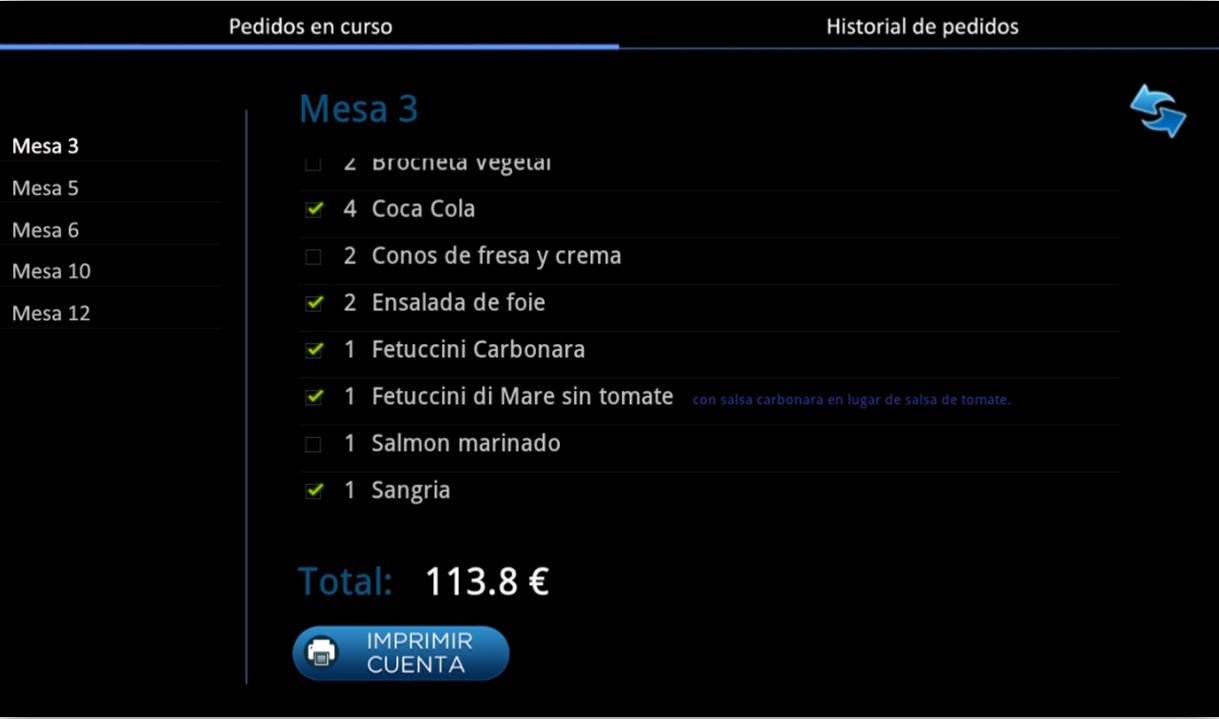
I built the complete product ecosystem from scratch. The solution included:
Construí el ecosistema de producto completo desde cero. La solución incluía:
Customer experience
- Android tablet application
- Digital menu
- Ordering workflow
- Table interaction
- Waiter assistance
Restaurant operations
- Order management
- Kitchen workflow
- Prioritisation and alerts
Management
- Data collection
- Database architecture
- Operational information
- Metrics and management insights
Technology
- Android application
- Server-side architecture
- Database
- Component communication
Experiencia del cliente
- Aplicación para tablet Android
- Menú digital
- Flujo de pedido
- Interacción con la mesa
- Asistencia del camarero
Operativa del restaurante
- Gestión de pedidos
- Flujo de cocina
- Priorización y alertas
Gestión
- Recopilación de datos
- Arquitectura de base de datos
- Información operativa
- Métricas e información de gestión
Tecnología
- Aplicación Android
- Arquitectura del lado del servidor
- Base de datos
- Comunicación entre componentes
The important part wasn't any individual feature.
It was making all of these pieces work together as one system.
Lo importante no era ninguna funcionalidad individual.
Era conseguir que todas estas piezas funcionaran juntas como un solo sistema.
The project was successful academically and technically. I delivered a fully working product rather than a prototype or a purely conceptual solution, and it graduated with Honors.
But the most valuable feedback came later.
As I casually described Touch & Eat to restaurant owners, I noticed something I hadn't anticipated during development. The response wasn't excitement. It was often hesitation.
And eventually I understood why.
For the diner, a tablet might remove waiting. But it could also remove something valuable: the human interaction at the heart of the restaurant experience.
A waiter doesn't just take an order. They welcome you, guide you to your table, answer questions, make recommendations and create a sense of hospitality.
I had optimised one part of the experience without fully understanding the value of everything surrounding it. And that changed how I think about product decisions.
El proyecto fue un éxito académico y técnico. Entregué un producto totalmente funcional en vez de un prototipo o una solución puramente conceptual, y obtuvo Matrícula de Honor.
Pero el feedback más valioso llegó después.
Al describir Touch & Eat de forma informal a dueños de restaurantes, noté algo que no había anticipado durante el desarrollo. La respuesta no era entusiasmo. Muchas veces era duda.
Y con el tiempo entendí por qué.
Para el comensal, una tablet podía eliminar la espera. Pero también podía eliminar algo valioso: la interacción humana en el corazón de la experiencia del restaurante.
Un camarero no solo toma nota. Te recibe, te acompaña a la mesa, responde preguntas, hace recomendaciones y crea una sensación de hospitalidad.
Había optimizado una parte de la experiencia sin entender del todo el valor de todo lo que la rodeaba. Y eso cambió cómo pienso las decisiones de producto.
The biggest lesson wasn't technical. It was this:
A solution can be beautifully designed, technically sound and completely wrong for the context in which it will be used.
I had focused heavily on what could be improved through technology. I hadn't spent enough time understanding what shouldn't be removed.
That experience taught me to distinguish between friction that should be removed and friction that actually creates value.
It also showed me the importance of validating desirability before investing heavily in feasibility.
And personally, the project taught me something else. I discovered that I had developed enough technical and problem-solving skills during my degree to take a product from an idea to a working system. I also discovered that it took considerably longer than I expected — my first real lesson in estimation, planning and scope management.
It was one of the experiences that made me realise how much I enjoyed thinking about how to turn an idea into something that can actually be delivered. That eventually led me towards Project Management, and later Product Management.
La mayor lección no fue técnica. Fue esta:
Una solución puede estar bellamente diseñada, ser técnicamente sólida y estar completamente equivocada para el contexto en el que se usará.
Me había centrado mucho en lo que se podía mejorar gracias a la tecnología. No había dedicado suficiente tiempo a entender qué no debía eliminarse.
Esa experiencia me enseñó a distinguir entre la fricción que debe eliminarse y la fricción que en realidad aporta valor.
También me mostró la importancia de validar la deseabilidad antes de invertir mucho en la viabilidad.
Y a nivel personal, el proyecto me enseñó algo más. Descubrí que había desarrollado suficientes habilidades técnicas y de resolución de problemas durante la carrera como para llevar un producto de la idea a un sistema funcionando. También descubrí que llevaba mucho más tiempo del que esperaba — mi primera lección real de estimación, planificación y gestión del alcance.
Fue una de las experiencias que me hizo darme cuenta de cuánto disfrutaba pensando en cómo convertir una idea en algo que realmente se puede entregar. Eso acabó llevándome hacia Project Management, y más tarde hacia Product Management.
Almost everything would start differently.
Today, I wouldn't begin by asking:
"What can I build to solve this?"
I'd start with:
"Do restaurant customers and owners actually want this problem solved?"
I would spend more time talking to restaurant owners, waiters, kitchen staff and diners before designing the solution. I would test the assumptions behind the idea before investing in the architecture. I'd probably explore several possible solutions before committing to a tablet-based ordering system.
And I would explicitly investigate a question I missed the first time: which parts of the restaurant experience are valuable precisely because they are human?
The irony is that the technology I built was not necessarily the wrong technology.
I simply hadn't understood the product deeply enough before deciding what to build.
That lesson has stayed with me ever since. It is one of the reasons I now care so much about understanding people, challenging assumptions and finding the real problem before building the solution.
Casi todo empezaría de forma diferente.
Hoy, no empezaría preguntando:
"¿Qué puedo construir para resolver esto?"
Empezaría con:
"¿De verdad quieren los clientes y dueños del restaurante que se resuelva este problema?"
Dedicaría más tiempo a hablar con dueños de restaurantes, camareros, personal de cocina y comensales antes de diseñar la solución. Pondría a prueba las suposiciones detrás de la idea antes de invertir en la arquitectura. Probablemente exploraría varias soluciones posibles antes de comprometerme con un sistema de pedidos basado en tablet.
E investigaría explícitamente una pregunta que se me pasó la primera vez: ¿qué partes de la experiencia del restaurante son valiosas precisamente porque son humanas?
La ironía es que la tecnología que construí no era necesariamente la tecnología equivocada.
Simplemente no había entendido el producto lo suficientemente a fondo antes de decidir qué construir.
Esa lección se ha quedado conmigo desde entonces. Es una de las razones por las que ahora me importa tanto entender a las personas, cuestionar suposiciones y encontrar el problema real antes de construir la solución.
There were hundreds of them — from defining the MVP and deciding which features belonged in the first release, to choosing technologies, designing the database architecture and determining which information mattered most on each screen.
I had to make decisions across the entire product:
- What problem to prioritise
- Which users and workflows to support
- What belonged in the MVP
- What could wait for a later version
- Which technology to use
- How the system should be architected
- How data should be structured
- Which information mattered most to diners
- How kitchen staff should receive and prioritise information
- Which management information would actually be useful
Because there was no product team to defer decisions to, every product, UX and technical decision ultimately came back to me.
That was my first real experience of product ownership.
Fueron cientos — desde definir el MVP y decidir qué funcionalidades entraban en la primera versión, hasta elegir tecnologías, diseñar la arquitectura de la base de datos y determinar qué información importaba más en cada pantalla.
Tuve que tomar decisiones sobre todo el producto:
- Qué problema priorizar
- Qué usuarios y flujos de trabajo dar soporte
- Qué entraba en el MVP
- Qué podía esperar a una versión posterior
- Qué tecnología usar
- Cómo debía estar arquitecturado el sistema
- Cómo debían estructurarse los datos
- Qué información importaba más a los comensales
- Cómo debía recibir y priorizar la información el personal de cocina
- Qué información de gestión sería realmente útil
Como no había un equipo de producto al que delegar decisiones, cada decisión de producto, UX y técnica acababa recayendo en mí.
Esa fue mi primera experiencia real de ownership de producto.
Product Management skills demonstratedHabilidades de Product Management demostradas
Product discovery
Identifying an opportunity, researching the market and questioning how an existing experience could be improved.
User research
Talking to people from different backgrounds to understand how they might interact with the product.
Multi-stakeholder thinking
Designing for diners, restaurant staff, kitchen operations and business owners, each with different needs.
Problem framing
Breaking one broad opportunity into several interconnected problems across the restaurant ecosystem.
Strategy & prioritisation
Defining the MVP and deciding what to build now versus what could wait.
UX & interaction design
Designing interfaces and workflows for different users and contexts.
Technical product thinking
Understanding the technical implications of product decisions, from architecture to database design.
End-to-end ownership
Taking responsibility for the entire journey from opportunity to research, design, development and delivery.
Delivery & planning
Estimating work, managing scope and learning how difficult it is to translate an ambitious idea into a realistic plan.
Critical thinking
Recognising, in hindsight, that solving a visible friction point doesn't necessarily improve the overall experience.
Learning from failure
Understanding that a successful implementation can still reveal that the original assumption was wrong.
Product discovery
Identificar una oportunidad, investigar el mercado y cuestionar cómo podría mejorarse una experiencia existente.
Investigación de usuarios
Hablar con personas de perfiles distintos para entender cómo podrían interactuar con el producto.
Pensamiento multi-stakeholder
Diseñar para comensales, personal del restaurante, operativa de cocina y dueños del negocio, cada uno con necesidades distintas.
Framing del problema
Dividir una oportunidad amplia en varios problemas interconectados dentro del ecosistema del restaurante.
Estrategia y priorización
Definir el MVP y decidir qué construir ahora frente a qué podía esperar.
Diseño de UX e interacción
Diseñar interfaces y flujos para distintos usuarios y contextos.
Pensamiento técnico de producto
Entender las implicaciones técnicas de las decisiones de producto, desde la arquitectura hasta el diseño de la base de datos.
Ownership de principio a fin
Responsabilizarme de todo el recorrido: oportunidad, investigación, diseño, desarrollo y entrega.
Entrega y planificación
Estimar trabajo, gestionar el alcance y aprender lo difícil que es traducir una idea ambiciosa en un plan realista.
Pensamiento crítico
Reconocer, con perspectiva, que resolver un punto de fricción visible no siempre mejora la experiencia global.
Aprender del fracaso
Entender que una implementación exitosa puede seguir revelando que la suposición original era errónea.